Disclosing AI Content on YouTube: What the Label Actually Covers
There is a belief among faceless creators that I keep running into, usually phrased as a shrug: it is an AI video, you just upload it. That was more or less survivable a few years ago. It is not the way the platform works now, and the gap between what creators assume and what the rules actually say is where channels get themselves into trouble.
The useful thing is that the rule is narrower and more sensible than the panic around it. YouTube is not trying to work out how much AI you used. It is trying to work out whether a viewer could mistake what you made for a recording of something real.
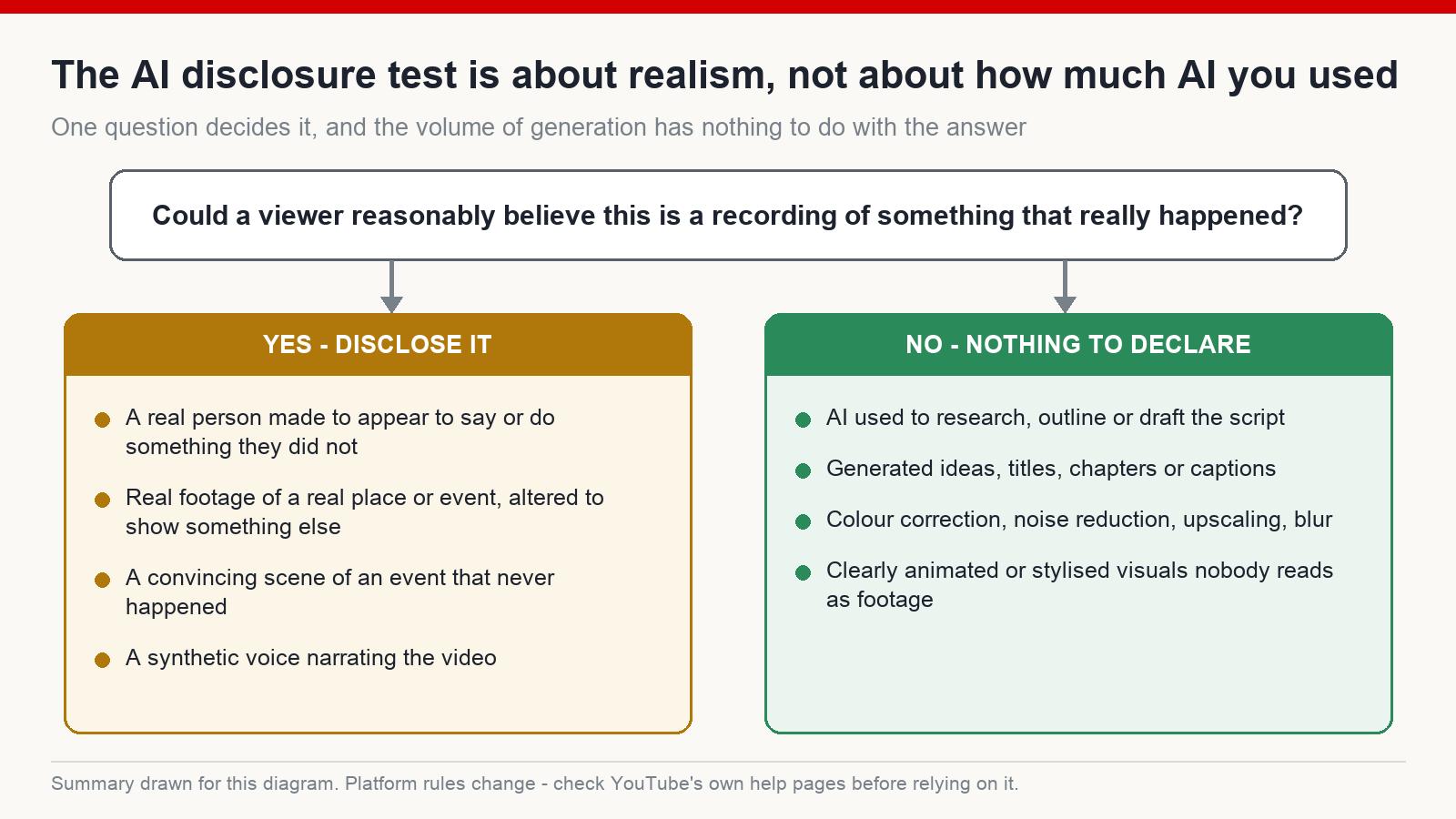
The Test Is Realism, Not Whether AI Was Involved
This is the part most people get backwards. Creators ask “did I use enough AI to need the label?” when the question the policy actually asks is “does this look like it really happened?”
An obviously stylised animation of a dragon burning down a castle involves an enormous amount of synthetic generation and needs no disclosure at all. A photorealistic clip of a flooded street in a town that exists, presented as footage, needs disclosure even if it took you thirty seconds to produce. The volume of AI is irrelevant. The believability is the whole test.
What Actually Has to Be Disclosed
Three families of content sit firmly on the disclose side, and every one of them is common in faceless production.
A real person made to appear to say or do something. Face swaps, cloned voices, a public figure delivering words they never delivered. This is the category the whole policy was written around, and it is also the one most likely to attract a complaint from the person involved rather than just a policy flag.
Real footage of a real place or event, altered. Changing what a building looks like, adding something to a street scene, editing a recording of an actual event so it shows something that did not occur.
A realistic scene of something that never happened. A convincing rendering of a disaster, a conflict, an accident, an interview that was never conducted. This is where a lot of AI documentary and AI news content quietly crosses the line.
Synthetic narration belongs in this conversation too. A generated voice reading your script is the single most common AI element on faceless channels, and it falls on the disclose side of the boundary rather than the ignore side. Ticking that box costs you nothing.
What You Do Not Have to Declare
Plenty of AI work in a normal production pipeline requires no disclosure whatsoever, and creators regularly over-disclose out of nervousness.
- Using AI to research, outline or draft a script
- Generating ideas, titles, chapters or captions
- Colour correction, noise reduction, upscaling, background blur
- Clearly animated or stylised visuals nobody would read as footage
- Beauty filters and other cosmetic adjustments
The principle underneath the list is consistent: production assistance is not the target. Simulated reality is.
Where the Label Ends Up
When you disclose during upload, the result is not a warning banner across your video. For most content the note sits in the expanded description, where a viewer has to open the description to see it. For sensitive subjects — health, news, elections, finance — the label is shown more prominently on the video itself, which is exactly where a viewer benefits from knowing.
Worth knowing: the platform can apply the label to your video without you, particularly on realistic content covering sensitive topics. Choosing not to disclose does not reliably mean the video goes out unmarked. It means you gave up control over how the marking happens.
Does the Label Cost You Views?
This is the real reason creators avoid disclosing, so let me be honest about the limits of what I can tell you. I cannot measure what the recommendation system does with a disclosure flag, and neither can anyone selling you a confident answer about it. Nobody outside the platform sees that machinery.
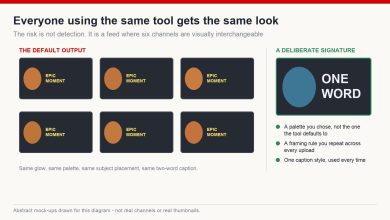
What I can say is what I have watched sink videos repeatedly, and it is never the label. It is thin production, a template repeated forty times with the nouns swapped, a thumbnail promising something the video never delivers, and openings that give a viewer no reason to stay. Those problems are visible in your own analytics, and they are fixable.
If you want to know whether disclosure changed anything on your channel, the only honest comparison is against yourself: the median views and retention of your last ten videos over a comparable window, not somebody’s screenshot. And even then, one video proves nothing. Results vary.
What Happens If You Skip It
The documented consequences for a pattern of undisclosed synthetic content run from removal of the content through to removal from the partner programme. That is the stated policy, not a rumour, and the phrase that matters in it is a pattern — this is aimed at creators who build a channel on undisclosed simulation, not at someone who forgot a checkbox once.
There is a second route people forget about entirely. Someone whose face or voice has been synthesised can submit a privacy complaint about it directly. That process does not care how your video was labelled or how well it performed.
And policies here are moving quickly. Anything you read about disclosure, including this, should be checked against YouTube’s own help pages before you build a workflow on it.
The Rule That Worries Faceless Creators More
In practice, the disclosure checkbox is not what costs most AI channels their monetisation. The rules about mass-produced and repetitive content are.
That policy is not about AI either. A channel can be entirely AI-assisted and perfectly monetisable if each video carries genuine commentary, structure, research or a point of view. A channel can be entirely human-made and fail the same test if every upload is the same template with a different subject dropped in. The question being asked is whether a person meaningfully shaped this, not which tools were open while they did.
The Workflow That Stays Clear of All This
The distinction I use when planning a channel is simple: is AI doing the production, or is AI doing the pretending?
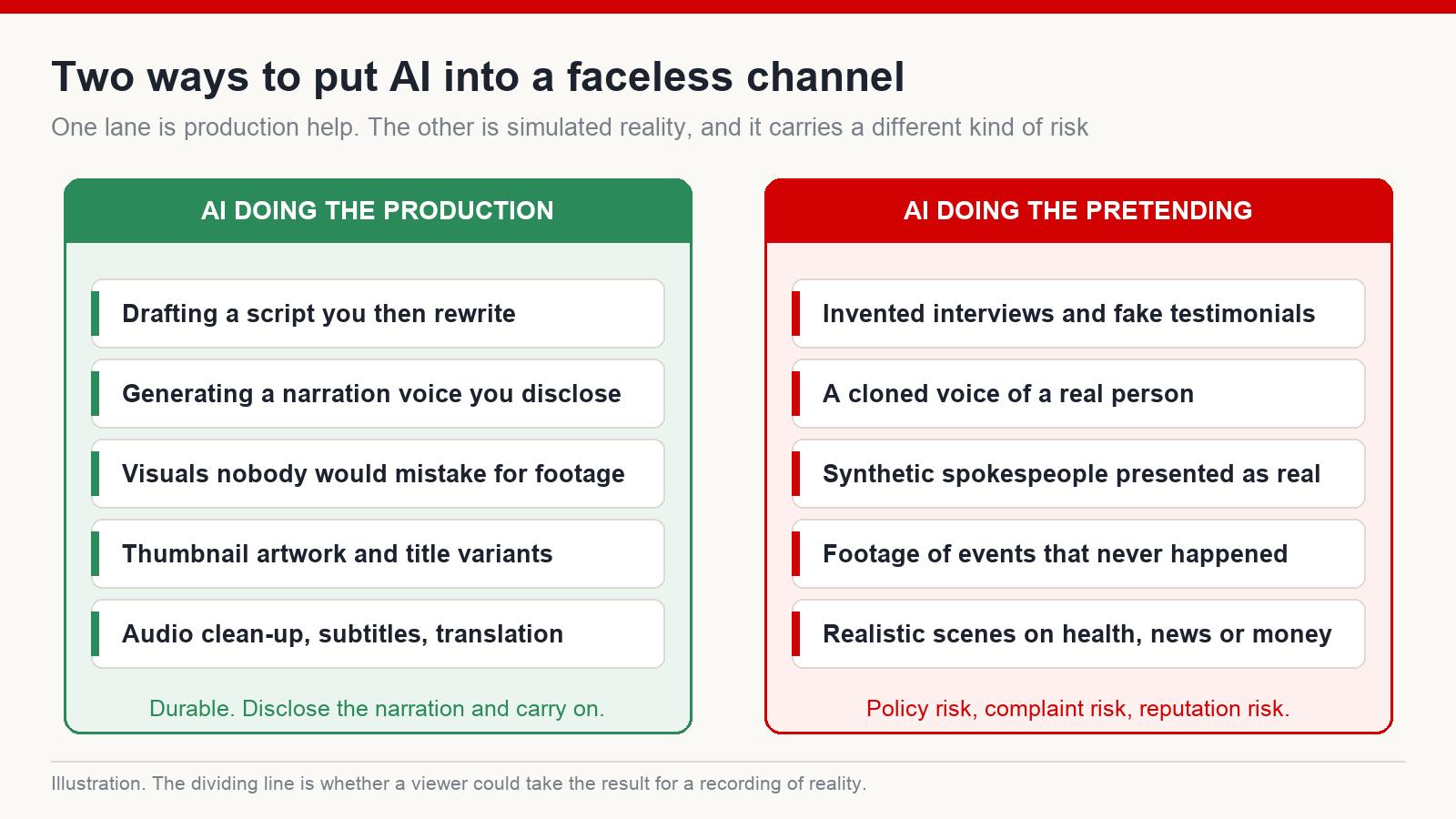
AI drafting a script you then rewrite, generating a narration voice you disclose, building visuals nobody would mistake for footage, producing thumbnail art, cleaning up audio — all of it sits in the production lane, and the whole lane is durable.
Fake testimonials, invented interviews, synthetic spokespeople presented as real, a cloned celebrity voice, staged footage of events that never happened — that is the pretending lane, and it carries policy risk, complaint risk and, if you ever want to work with brands, reputational risk that outlives any single video.
The Thing Nobody Warns You About
One last observation from watching a lot of these channels. The faceless projects I see fail rarely fail because of AI detection or a disclosure flag. They fail because the content has no personality in it.
Viewers spot the shape of a machine-written script surprisingly fast. What holds attention is the same as it has always been: a point of view, a fact worth remembering, a rhythm to the delivery, a reason for this video to exist rather than the four hundred others on the same subject. AI can produce all the components of a video and still leave you with nothing anybody wants to finish watching.
Which is where I would leave the whole subject. AI is not the problem the platform is trying to solve. Pretending is. Get the labelling honest, keep a human in charge of the judgement, and the disclosure question stops being frightening and becomes a checkbox on the way to publish.
Does an AI narration voice need to be disclosed?
A synthetically generated voice narrating your video falls on the disclosure side of the line, and a voice imitating a specific real person certainly does. Ticking the box costs you nothing, so there is no reason to gamble on it.
Do AI-generated thumbnails need disclosure?
The disclosure applies to your video content. A stylised illustrated thumbnail is not the issue — but a thumbnail showing a realistic scene that never happens in the video is a misleading-packaging problem regardless of how it was produced.
Is it safer to avoid AI altogether?
No, and that is not what the policy asks for. Enormous numbers of AI-assisted channels operate normally. What gets punished is simulation without transparency and volume without value.
Can I just not tick the box and see what happens?
I would not. The platform can apply a label itself, the review of past uploads is not a one-time event, and the upside of hiding it is nothing. You are trading a line in your description for a risk to the whole channel.
If you want the full picture of building a faceless channel for an English-speaking audience — niche research, packaging and a production workflow that stays inside the rules — that is what I teach at mmoyoutube.com.